A plain English checklist for keeping your AI assisted content safe, credible and ranking.
Did your traffic dip in late September? Before you panic, know this: Google rolled out a global spam update on 24 September 2026, and it kept shifting rankings for about two weeks.
The timing matters because Google has also been blunt about AI content lately. Use it carelessly, and you could be in trouble. Fact-check it, put a real person’s name on it, and you’re on much safer ground.
Many business owners now use AI to write blog posts, service pages, and product descriptions. That’s not the problem. The problem is how it’s being used, and what gets published without anyone checking it. This guide explains what changed, what Google actually says, and what to check on your own site this week
What actually happened
Google announced the update on 24 September and called it a normal spam update, applied globally and to every language. Trackers picked up the biggest swings in the first few days, then again around 30 September and in the first week of October.
Google didn’t say which spam policies it was targeting. So when someone online tells you exactly what the update targeted, take it with a pinch of salt. Nobody outside Google knows for sure.
What we do know is that Google puts this year’s run of spam updates down to the sheer amount of new content being published, and that it now uses AI itself to help catch spam. More content gets made every month, so the filters are getting tougher.
Two things to keep in mind. First, a dip while the update was rolling out doesn’t automatically mean your site got flagged. Rankings bounce around during updates, and they often settle again. Second, if a site was hit, recovery isn’t quick. It can take months of steady improvement before Google reassesses it.
What Google’s spam policies actually say
It helps to read the source instead of the rumours. Google’s spam policies cover several things, and three of them matter for most small businesses.
Scaled content abuse. This is when many pages are created mainly to manipulate search rankings, rather than to help people. Google lists several examples. One is using generative AI tools to generate many pages without adding value for users. Others include scraping content and changing it through automated tricks like swapping in synonyms or translating it, and creating lots of pages that make little sense to a reader but are stuffed with search keywords. Google also names creating several sites to hide how much content is being mass-produced.
The important point is that the policy applies however the content is made. A person copying and rewording other sites can break it just as easily as a tool can.
Site reputation abuse. This covers third-party content published on a well-established site mainly to borrow that site’s ranking strength. If you let outside writers or partners publish pages on your domain, those pages need to be there for your readers, not just to ride on your reputation.
Expired domain abuse. This is when someone buys an old domain and fills it with low-value content to take advantage of its history. It’s unlikely to affect you unless you’ve done it, but it shows that Google looks at intent as well as the content itself.
None of this is new. What’s changed is how much content is out there, and how good Google’s systems are at spotting patterns.

So, does Google punish AI content?
No. Google doesn’t penalise a page just because AI helped write it. What it goes after is content made mainly to game the rankings.
The words that matter in the policy are “without adding value”. Google’s helpful content guidance goes further. Pumping out lots of AI text with no oversight, it says, “represents little to no effort”. Google has also updated its guidance to say AI content should be manually fact checked and reviewed before it goes live.
Here’s what tends to land sites in hot water:
1. Dozens of near-identical pages where only the town or service name changes
2. Articles published in bulk with nobody reading them first
3. Bland text that could sit on any competitor’s website
4. Prices, laws, or facts that nobody bothered to check
Picture a local plumber who asks a tool for 200 pages, one for every postcode in the county, each saying the same thing with a different place name. Nobody has read them, and none of them says anything a customer couldn’t find on ten other sites. That is exactly what the policy describes.
Now picture the same plumber writing five pages about real jobs, with real photos, real prices and real advice, using AI to tidy the wording. Same tool, completely different result.Use AI to speed up the boring parts, and you’re fine. Use it to replace the thinking, and you’re not.
Who, how and why: the three questions Google wants answered
Google’s guidance gives a simple way to judge your own content. It asks three questions.
Who? Is it obvious to your visitors who wrote this? A clear byline and a short bio answer that.
How? Google says it’s helpful for readers to know how a piece of content was produced. If AI or automation played a big part and readers might wonder about it, saying so is useful.
Why? Google calls this perhaps the most important question. Is the page there mainly to help people, or mainly to attract search traffic? If you’re honest about the answer, you’ll know whether a page is at risk.
Google also says that of all the quality signals, trust is the most important. E-E-A-T (experience, expertise, authoritativeness and trust) isn’t a direct ranking factor on its own. But Google’s systems favour content that shows these qualities, and they give even more weight to it on topics that could affect someone’s health, money or safety.
Why a fake author can hurt you
Its guidance encourages a proper byline that links to a short bio, and it warns against deceptive authorship. Google’s examples include made-up names, synthetic profile photos, and false credentials. Any form of deception, it says, makes a page untrustworthy.
Some sites do this to look more established. A blog with five “experts” who don’t exist might seem harmless, but it’s exactly the kind of thing Google calls out. If you get found out, you lose reader trust as well as ranking potential.
If you run a small business, the honest fix costs nothing. Publish under the real people on your team. Give them a genuine photo, a short bio, and a link to their LinkedIn profile. A named person with real experience is more trustworthy than an anonymous blog, to readers and to search engines.
How to check whether you were affected
Don’t guess. Search Console will tell you much more than a gut feeling. Here’s how to look.
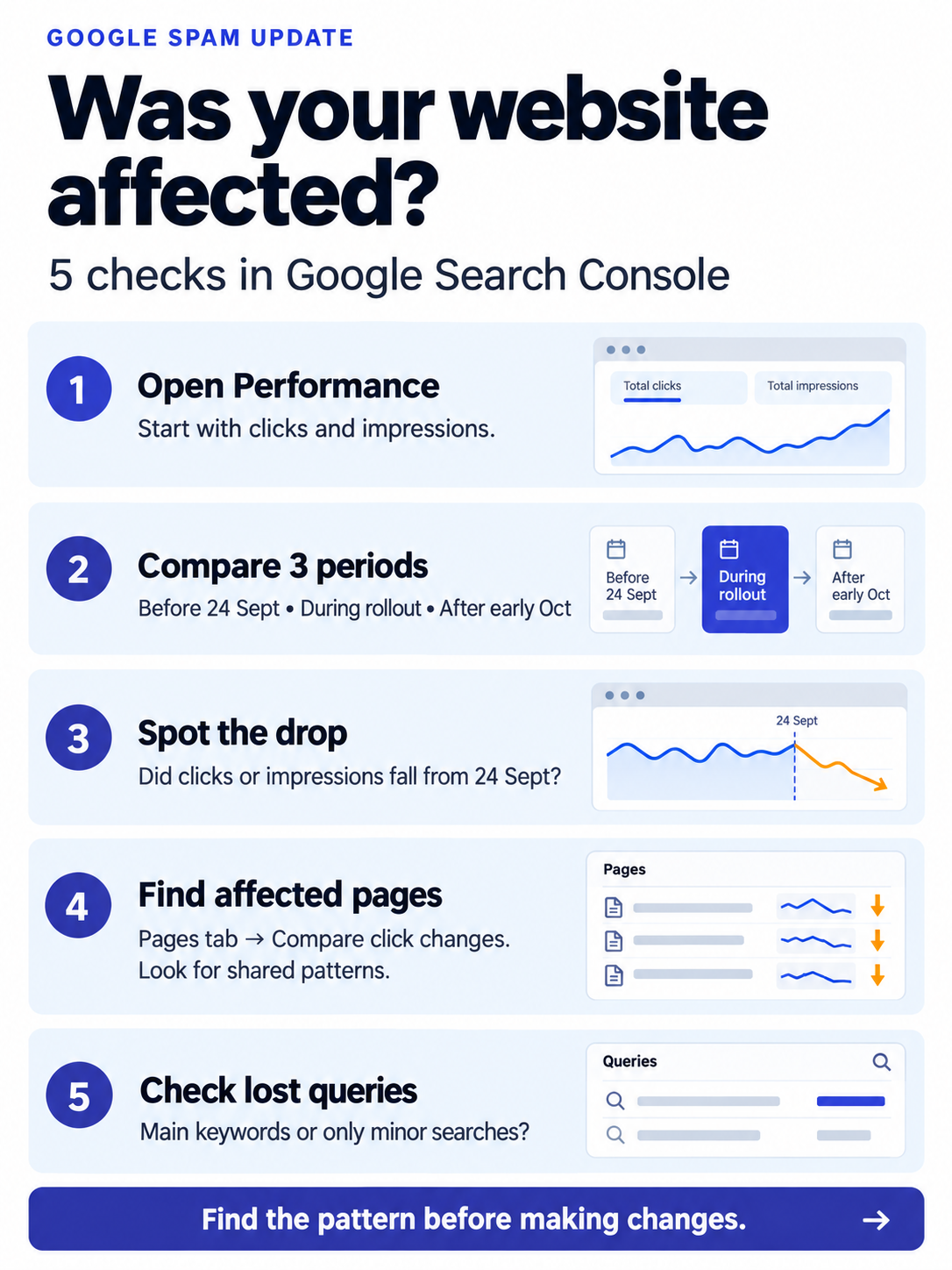
1. Open the Performance report in Google Search Console.
2. Set the date range to compare three periods: the weeks before 24 September, the weeks during the rollout, and the period after it settled in early October.
3. Look at total clicks and impressions first. Is there a drop that begins on or just after 24 September?
4. Switch to the Pages tab and sort by change in clicks. Are the pages that fell similar in some way? For example, all written in the same batch, or all created with the same tool?
5. Check the Queries tab for the pages that fell. Did you lose rankings for the main keyword, or only for a few minor ones?
If your drop began before 24 September, the update probably isn’t the cause. Look at seasonality, technical changes to your site, or competitors who’ve improved. If the drop started on those dates and the pages affected share an obvious weakness, you’ve found where to focus.
Wait for the rollout to settle before concluding. One bad week proves very little.
A safer way to use AI for content
You don’t need to stop using AI. You need a process around it. A simple one looks like this:
Start with real knowledge. Before opening any tool, write down what you actually know about the topic. What do customers ask you? What mistakes do you see? What would you tell a friend?
Use AI for structure and drafting. It’s good at outlines, first drafts, and tidying up rough notes.
Edit it properly. Cut the filler, fix the tone, and make it sound like your business. If a sentence could appear on any website, rewrite it or delete it.
Fact-check. Verify every number, date and claim against a reliable source.
Add your own experience. A real example, a photo, a story from a job. This is what makes a page worth reading.
Publish under a real name. The author should have read it, agree with it, and be happy to put their name to it.
Review it later. Check old pages every few months. Update anything that’s out of date.
That’s slower than pressing a button. It’s also what protects your rankings.
The bottom line
This update is a nudge, not a surprise. Quality, accuracy and real expertise beat sheer volume. If you use AI carefully, with real people and real insight behind every page, you’re in good shape. If you publish in bulk and hope for the best, you’re taking a risk.
The good news is that the fix is mostly common sense. Know who wrote it, check that it’s true, and make sure it helps the person reading it.

How we can help
At Quantum DMA, we help UK businesses create content that’s original, credible and built to rank. We can look through your existing pages, flag anything that could put your rankings at risk, and plan a content strategy that uses AI sensibly, with real people behind it.
Not sure if your site was hit? Book a free consultation at quantumdma.co.uk, and we’ll take a look.