A practical guide for small businesses running Google and Meta ads between now and January.
Every year, the same thing happens. In early October, ad accounts that have been ticking along quietly start to get more expensive. By late November, the same budget buys noticeably less. Then January arrives, costs drop, and plenty of businesses are left wondering where their money went.
If you advertise on Google or Meta, that cycle is starting now. The good news is that it is predictable, which means you can plan for it. This guide explains why Q4 ad costs rise, how to divide your budget across the next three months, and what to get ready this week.
Why ad costs rise in Q4
In the last quarter of the year, more businesses compete for the same audience at the same time. Retailers chase Christmas shoppers, brands push Black Friday offers, and everyone bids for the same people on the same platforms. Ad platforms run on auctions, so when demand goes up, prices go up for everyone, including businesses that have nothing to do with Christmas. Smaller advertisers feel this most, because large brands can absorb higher costs while a fixed monthly budget simply buys fewer results.
How much? Estimates vary. Agency benchmarks put the Q4 increase in costs on Meta and Google somewhere between roughly 25% and 80% compared with the rest of the year, depending on the platform and who you ask. Treat that as a range, not a promise. Your own costs will depend on your industry and audience, and narrow audiences such as small retargeting pools tend to cost more. Agency guidance also suggests the sharpest rises land in the final two weeks of November.
The calendar matters too. Black Friday is on Friday 27 November 2026, and Cyber Monday follows on Monday 30 November. But many UK retailers start their Black Friday deals around 21 November, and some campaigns may begin as early as late October. In practice, peak starts earlier than the date suggests.
The core idea: build early, capture late
Meta and Google do different jobs, and Q4 planning works best when you treat them that way. Meta is strongest at building demand, putting your brand in front of people before they are ready to buy. Google is strongest at capturing demand, showing your ad at the moment someone searches for exactly what you offer.
That points to a simple rule. Do your building early, while it is cheaper, and save your capturing for the weeks when buyers are ready. Spend should follow the calendar, not run flat.
A useful rule of thumb for the total: your share of annual ad budget spent in Q4 should be at least your share of annual revenue earned in Q4. If 30% of your sales arrive in the last quarter, put at least 30% of your yearly ad budget there. If you sell services rather than products, use your share of new enquiries instead.
A four-phase Q4 budget plan
Here is a simple structure you can adapt. The percentages are an example, not a rule, so adjust them to your own sales pattern.
| Phase | Dates | What to focus on | Share of Q4 budget |
|---|---|---|---|
| 1. Build | 7 Oct to 8 Nov | Test creative, build audiences, fix tracking. Meta leads, with Google search running as a baseline. | 25% |
| 2. Warm up | 9 Nov to 20 Nov | Raise awareness while costs are still below peak. Grow retargeting pools. | 30% |
| 3. Peak | 21 Nov to 1 Dec | Capture ready buyers with Google search and Meta retargeting. Lead with your strongest offer. | 30% |
| 4. Last orders | 2 Dec to your cut-off date | Urgency messaging around delivery or booking deadlines, then wind down. | 15% |
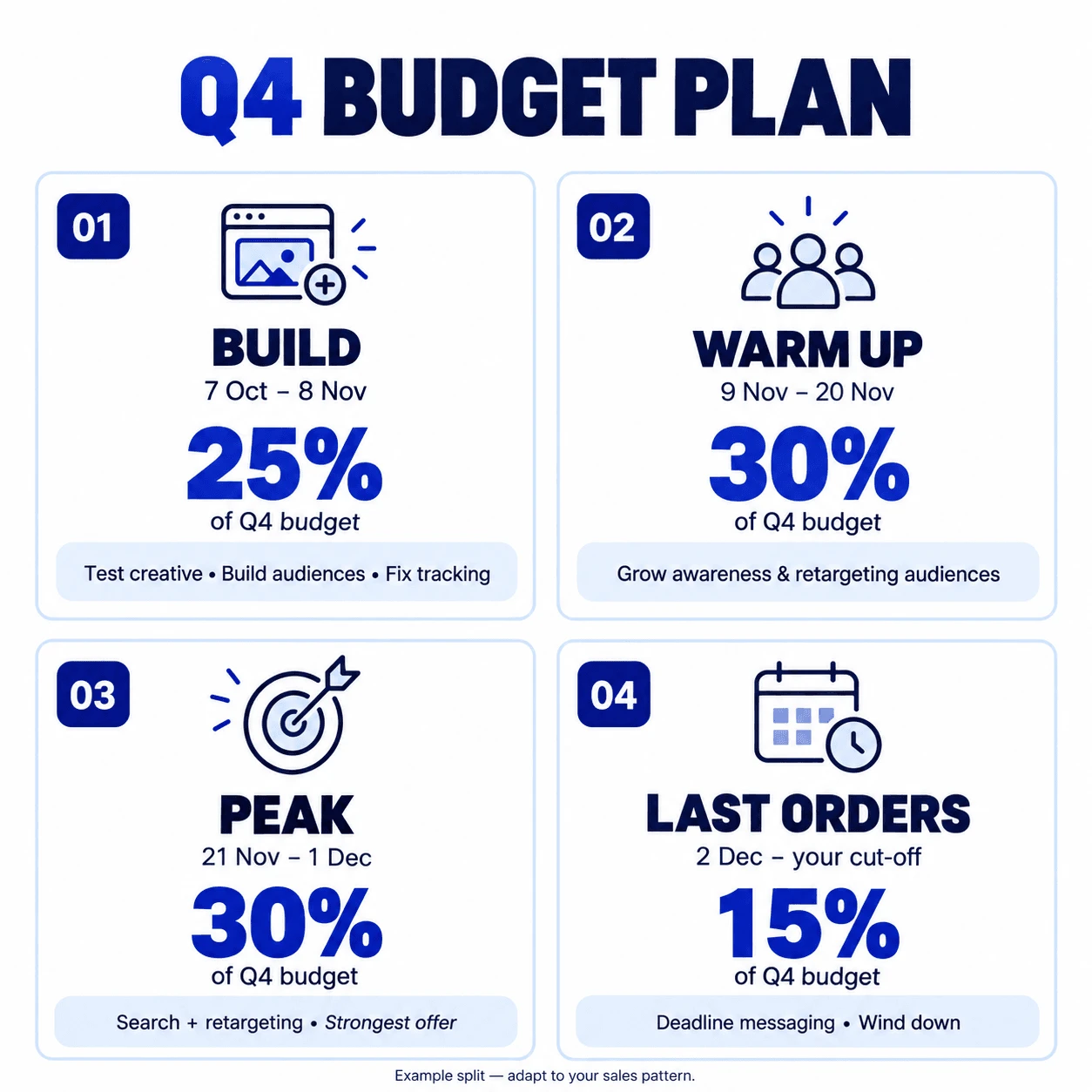
Take a business with £3,000 for the quarter. Phase 1 gets about £750, enough to test three or four ads and start filling audiences. Phase 2 gets £900 to build awareness while costs are still below peak. Phase 3 gets £900 for the weeks that matter most, and Phase 4 keeps £450 back for the final push and any winners worth backing. The point is not the exact numbers. It is that you decide the shape of the quarter before the auction decides it for you.
If you sell services, Black Friday may not apply to you, but the same auction pressure does, and decision-makers often slow down as Christmas approaches. For service businesses it usually makes sense to front-load: aim to capture enquiries by early December, then plan for January, when costs typically fall back after the holiday pullback in ad spend.
What to lock in this week
Audiences. Retargeting pools take time to fill, and small pools are expensive to reach. Start collecting website visitors, video viewers and past customers now, so there is a decent pool by mid-November.
Creative. Use Phase 1 to test three or four ad variations while costs are lower, so you only scale the winners at peak. Meta rewards ads that resonate, so a tested ad is worth more than an expensive untested one.
Tracking. Check that your Meta pixel and Google conversion tracking are recording what you think they are. If tracking is off, you cannot tell which phase is working. Check mobile too, because mobile has accounted for more than half of online Black Friday sales in recent years.
Offer and landing page. Decide your offer and your last-order or last-booking dates now. Make sure the page an ad sends people to matches what the ad promised, and loads quickly on a phone.
Account settings. Both platforms have changed how their automation works recently. Before you raise budgets, review your Google and Meta settings so the money goes where you intend. We covered the changes in our guide to the recent Google AI Max and Meta placement updates.
How to tell whether it is working
Q4 is noisy, so decide in advance what success looks like. Pick the one number that matters (cost per lead for service businesses, cost per sale for shops) and set a ceiling before the quarter starts. Then check four things each week:
- Cost per result against your ceiling, not against last month. Costs rise in Q4, so comparing with September will always look bad.
- Conversion rate on your landing page. If clicks are healthy but results are weak, the problem is the page, not the ad.
- Frequency, which is how often the same person sees your ad. If it climbs quickly on a small audience, your creative is wearing out.
- Retargeting pool size. This tells you whether Phases 1 and 2 built the audience you need for Phase 3.
Compare against the same weeks last year if you have the data, or against your own Phase 1 results if you do not. If a phase underperforms, move budget to what is working rather than adding new money.
Three mistakes to avoid
- Waiting until November to start. You will pay peak prices for untested ads.
- Spending evenly. A flat budget under-invests when costs are lower and gets less for the same money at peak.
- Judging results daily. Costs swing day to day in Q4. Review weekly, against a target you set in advance.
Your Q4 checklist
- Set your Q4 total using your share of annual revenue or enquiries
- Split it across four phases and note the dates
- Start building retargeting audiences this week
- Produce three or four ad variations to test in Phase 1
- Check Meta pixel and Google conversion tracking
- Confirm your offer, cut-off dates and mobile landing page
- Review Google and Meta account settings
- Book a weekly 20-minute review
Frequently asked questions
When should I start Q4 advertising?
Early to mid October for most businesses. That gives you time to test creative and build audiences while costs are lower. Starting in Black Friday week means paying peak prices for ads you have not tested.
How much do ad costs rise in Q4?
Agency estimates range from about 25% to 80%, depending on the platform and industry. The sharpest rise tends to come in late November, so your own account history is the best guide.
Is Black Friday worth it for service businesses?
Often not as a discount event, but Q4 still affects you through higher auction costs. Focus on capturing enquiries early, avoid the peak weeks unless you have a time-limited offer, and plan for January, when costs are typically lowest.
How much should I spend in Q4?
As a starting point, match your Q4 share of ad budget to your Q4 share of revenue or enquiries. Then adjust using your own results.
How we can help
Quantum plans and runs paid campaigns on Google and Meta, from the budget split and creative testing to tracking and transparent reporting. We will review where your accounts stand today, build a phase-by-phase plan for the rest of the year, and make sure every pound is working before costs peak. You can see how we approach paid media in our Halo Tuition case study, or book a free consultation and we will walk through your accounts with you.
Marketing built for growth.